

What No One Taught You in Grad School: Insurance Terms Decoded
By: Nicole Nguyen, LSCSW
If the world of insurance is confusing for you, you are not alone and this blog is for you! Deductibles, annual deductibles, co-pay, coinsurance, out-of-pocket maximums. What does all of this mean?!
I’m going to break it down for you in the most simplest terms so you will no longer have to guess what your client will owe, AKA, client's responsibility. You will have confidence in reading the Explanation of Benefits (EOB's), with complete understanding of how all of this insurance nonsense works!
Let’s start with basic terms.
Contracted rate is what the insurance has agreed to pay you. This rate is set when you agree and sign the contract during the credentialing process. This can be found in their fee schedule, which should be attached to your contract. If you didn't get the fee schedule, reach out to your provider rep to request one.
Your rate is what you charge insurance when you submit your claims. It is often not reimbursed fully because it is often (and should be) higher than what your contracted rate is. More on this later.
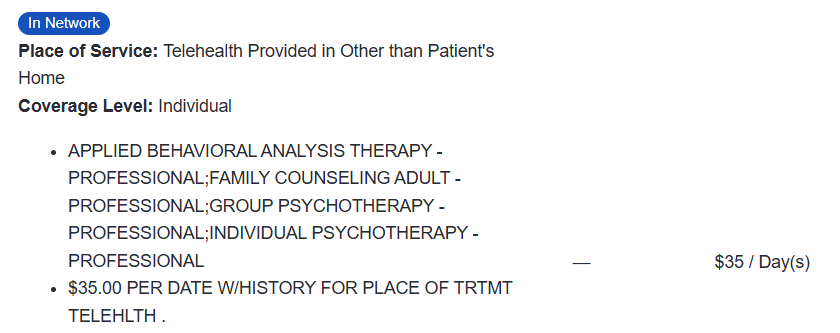
The co-pay is the amount the client owes per session. This is typically a flat number that does not change. Keep reading to learn when and why a client would no longer need to pay their co-pay!
Example of a co-pay shown in the photo below.
ow things start to get a little more chaotic, bare with me!
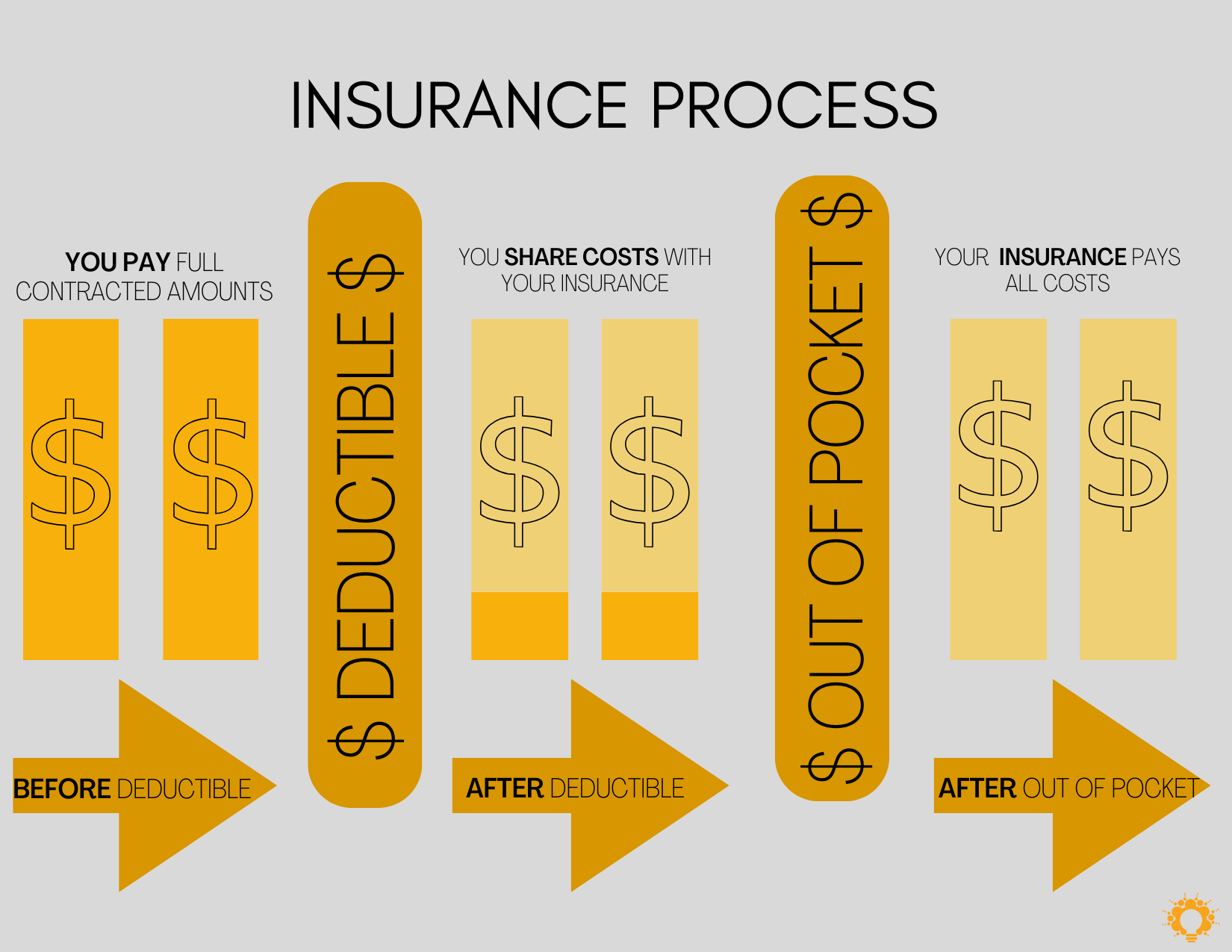
Co-Insurance is the percentage the client owes once the deductible is met. This means the client is responsible for 100% of the contracted rate until they have met their deductible.
Their Out-of-Pocket (OOP) Maximum is also important to note.
The OOP maximum is how much they will pay in the year. Once this is met, insurance pays 100% of claims due at the contracted rate. So what payments account for the OOP, you ask? Well, I certainly was not going to leave you wondering!
Co-pays
Co-insurance
Deductibles
Prescriptions Medications
A note to add on co-pays. When the OOP is met, the client will no longer have to pay the co-pay until the year starts over for their plan. Most commonly, health insurance plans restart in January. It is good to take note of this when reviewing EOB's.
This chart is a great example highlighting the process of co-insurances, deductibles, and OOP Maximums.
In-network providers have a contract. This means, if you are credentialed with an insurance company, you are in-network and submit the claims to the insurance company, typically through your EHR.
Out-of-Network providers do not have a contract. This is where a Superbill comes into play. If you are working with a client that holds an insurance you do not accept, you would collect payment from the client, at your rate, and provide them a superbill. The superbill is an itemized receipt that is required for their insurance to reimburse them. The client submits the superbill and receives the reimbursement from the insurance.
Now, to go back to why your rate should be higher than what your contracted rate is. Every insurance reimburses at a different rate, some extremely low, others are more reasonable. If your rate is set to $125, insurance A reimburses at $110, you will get the full reimbursement of $110, as that is your contracted rate with them.
Now, if insurance B reimburses at $150, but you only charge $125, you will get your full $125, but the other $25 is gone. You are essentially under paying yourself.
Lastly, without getting too deep in charging your worth (keep an eye out for that blog!) you DESERVE to be paid MORE than what insurance says you do! Set your rates based on what you are worth. I am going to end it on this, if you rate is less than $125, do you think you should reconsider this? More on that later!
If you enjoyed this blog, share it, tell friends and coworkers about it, and give me a follow for more! You are appreciated, you are deserving. Keep doing the work that makes a difference in this world.
If you found this blog to be resourceful, check out Mental Health Billing Reference Sheet!
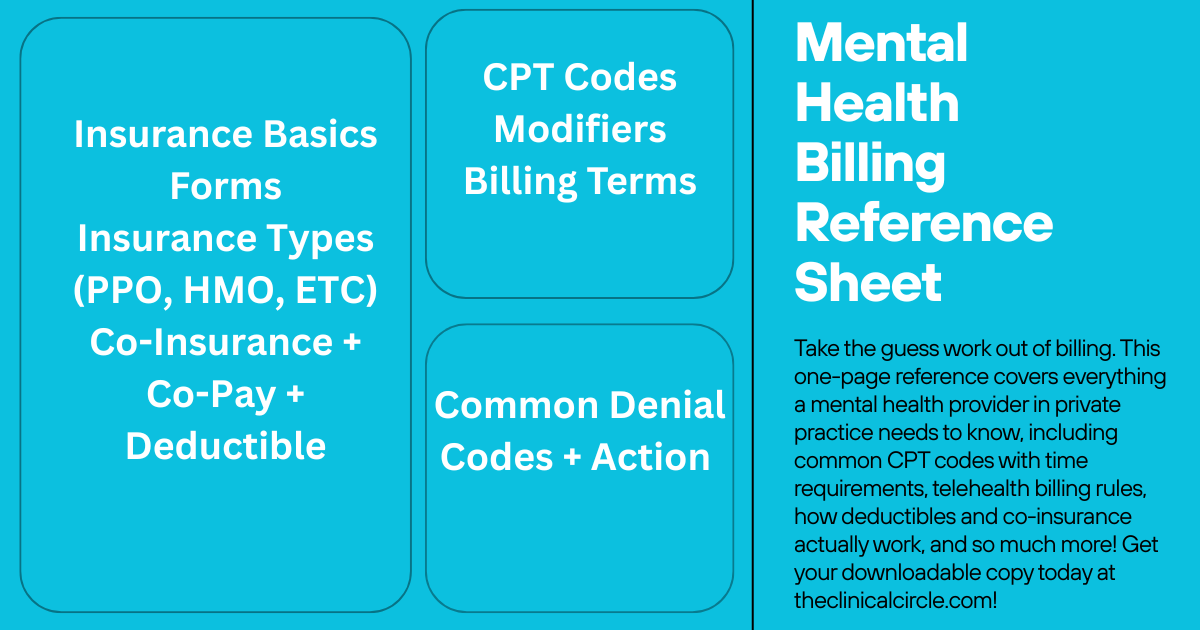
Does the world of mental health billing feel like it requires a second degree just to understand it? Between CPT codes, modifiers, denial codes, coordination of benefits, and knowing when your client actually owes you money, it can feel overwhelming, especially when you are also trying to show up fully for the people in your care.
The Mental Health Billing Reference Sheet was created to take the guesswork out of billing so you can spend less time deciphering insurance language and more time doing the work you trained for.